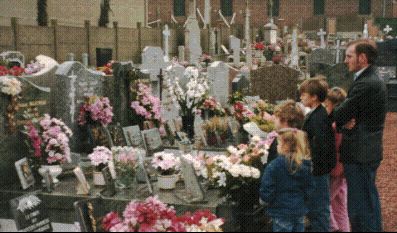
| RU486 : A KILLER PRODUCT |
THE FACTS
31 years old, Nadine WALKOWIAK had already four children from a first marriage,
and with Mr P., blue collar worker, five more, that they were rearing together at
home.
In March 1991, Nadine, wondering about a new pregnancy, consulted the family physician,
Doctor Patrick ANNIC. In a visit to Nadine's home, he prescribed a pregnancy test,
the results of which were supplied on March 19. The day after, he gave her a letter
for the "family planning" of Lens. On March 21, Nadine WALKOWIAK went
there and did the formalities necessary for an abortion, then was aborted immediately
by taking 3 tablets of MIFÉGYNE 200 mg (RU 486) in the presence of Doctor
PAS, physician of the abortion center of Lens.
The legal reflection waiting period (1 week) for an abortion application was thus
not respected.
On March 23, 1991 at 10:15 AM , Ms WALKOWIAK received an intramuscular shot of half
an ampoule (250 micrograms) of NALADOR. She died on the same day at 8 PM of a massive
coronary thrombosis.
So Mr P. is now alone to rear his five children, it forced him to quit his job,
because he refuses to put them in the D.A.S.S. (public orphanage) due to his paternal
love and his sense of parenthood duty.
Following this drama, the hospital pretends that this accident was unpredictable
at that time: this is not true (see Annex "A
Predictable Accident").
A TRUE JOURNALIST
This whole affair would have been kept confidential if a journalist of the regional
daily La Voix du Nord had not received a phone call from one of his informers in
the hospital. So he was able to go there immediately and to make an inquiry.
It is likely that governmental requests have been expressed to avoid too much noise
about this affair.
This and a simple understanding of statistics incite us to believe that Nadine WALKOWIAK
is not the only victim of RU 486; all the journalists have not good informers in
the hospitals.
THE PRELIMINARY INVESTIGATION RESTARTED
The accident was perfectly predictable, the physicians were in possesion of all
the data related to their patient and to the RU 486 drug; therefore only their casualness,
their rush, in one word their imprudence led them to choose that process.
In 1992, the pro-life association "La Trêve de Dieu" got in touch
with the family of Nadine WALKOWIAK. With their agreement, it decided to defend
and support them, through establishing a Support Committee to the Family of Nadine
Walkowiak.
We must explain that the family's former lawyer, routinely posted, was a Communist.
He did his job to lodge a complaint, but he did not "push" the dossier.
In September 1992 Maître de SAINT-JUST took charge of the affair. As a matter
of fact, the examining magistrate was at the point of closing the dossier by a nonsuit,
at the very time when he had not had access to some essential parts, especially
the death certificate issued by the post-mortem examination of Nadine.
In December 1992, Maître de Saint-Just thus brought new elements to the dossier
for investigation, this one so being reopened.
There are now two possible charges in this dossier:
- manslaughter (involuntary killing)
- fraud about the essential properties of a merchandise sold.
The people possibly wanted are among others:
- the physicians who prescribed the drug RU 486,
- the physicians who performed the abortion process,
- the civil servants and the public officers who permitted the administering of
this abortive product,
- the designers, makers and propagandists of the above mentioned substances.
The Support Committee distributed thousands of flyers in the Lens area, even inside
the hospital where Mr P. came with a friend to the abortion service to distribute
flyers. A young woman waiting her turn seeing the photo on the flyer given by Mr
P., asked: "Who is she?", he answered: "She is my wife."; she
suddenly understood the risks she was facing and canceled her appointment.
On December 30, 1992 in the evening, a demonstration was organized to commemorate
Nadine WALKOWIAK, in the presence of her husband and children. The local press came
(regional State TV FR3, the regional dailies La Voix du Nord and Nord Matin, the
national radio broadcasting station RTL). RTL diffused the news on the same evening
and the next morning; FR3 showed nothing; Nord Matin (socialist) scamped an aggressive
article towards Mr P. and the group La Trêve de Dieu, assimilating it the
first time to a "Protestant cult"! La Voix du Nord wrote a small but correct
article.
In the same week the press spoke about the wish of Clinton to import the RU 486
into the U.S.A. It seems that the news has probably not crossed the Atlantic Ocean:
RU 486 is a dangerous drug; those who distribute it, prescribe it, make it, will
be unceasingly sued; RU 486 is not a worthwhile business.
A PREDICTABLE ACCIDENT
The authorization to put on the market (A.M.M.) of the RU 486 associated to prostaglandins
(NALADOR) was granted, then constantly modified due to the deadly risks it represents,
alas, without it being withheld from marketing; if it had been the situation, Nadine
WALKOWIAK would not be dead.
The A.M.M. application was filed in the Health Ministry on Oct.9, 1987; it was examined
by the A.M.M. commission on Dec.18. In November, the Director of Pharmacy and Medicine
indicated to the Health Minister the "difficulties" set by RU 486:
"It seems desirable to realize an exhaustive evaluation of the technical,
judicial and ethical aspects of any definitive decision about the authorization
to put on the market of MIFÉGYNE".
Now, this exhaustive evaluation has never been done. The closest to such an evaluation
is the scientific report of the International Inquiry Commission on RU 486, which
has not been taken into consideration by the sanitary authority. In a note dated
Nov.27, 1987, the Health General Director also set reserves: sanitary, legal, ethical
and medical reserves. On account of these precarious and ambiguous conditions, the
A.M.M. commission, presided by Jean-Michel ALEXANDRE, with Roger HENRION as commission
reporter, "states a delay to pronounce an opinion because the dossier appeared
incomplete" and "the Commission then did not want to enter discussion
about the kind of view to express" (press release of the Health Ministry,
Jan.15, 1988).
On May 30, 1988, Roussel Uclaf provided the "complementary dossiers" to
the A.M.M. Commission. A new A.M.M. Commission met on Sept. 23, 1988. It had to
state something tangible about the combination of prostaglandins with mifegyne.
The evaluation is extremely questionable; as the commission observed:
"There are still some disadvantages:
- the existence of a teratogenic potential,
- the necessity for the woman to make a quick decision, in spite of the extra legal
waiting week (49 days of amenorrhea),
- the risk of losing contact with some women due to the process,
- the risk of ignoring an ectopic pregnancy,
- the risk of iso-immunization."
In spite of these disadvantages, and acknowledging also that "the RU should
be reserved for sufficiently instructed and responsible women" (...) "the
A.M.M. Commission made a positive decision about the use of mifepristone followed
by the above-mentioned prostaglandins' analogs" i.e.:
"gemeprost 1 mg, ovule (CERVAGEM) or Sulprostone 250 µg, IM (NALADOR)".
On the same day, Roussel Uclaf issued a press release, first among its units' managers
in France and abroad, and then to the public; it stated: "RU 486 has just
gotten the Authorization to be put on the market in France". It was a blatant
lie, because, even if the commission had given a positive opinion, it was only 3
months later that the A.M.M. was given by the Health Minister, for a duration of
5 years. The minister's decree was then published on Jan. 12, 1989.
As a strong public hostility to RU 486 campaign was fought by the opponents to abortion,
the gap between pro and con RU 486 widened inside the Roussel Uclaf company. Contrary
to the usual way of thinking, this gap was not only centered around moral criteria,
but instead about the opportunity to make and market this unsafe product. Finally,
a professionally ethical process led the Roussel group on Oct. 26, 1988 to suspend
the marketing of the product. Immediately, pretexting "the interest
of public health", the Health Ministry forced the group to cancel its
decision. That forcing was later canceled itself by the State Council, for "abuse
of power" on Jan. 25, 1991.
The International Inquiry Commission on RU 486, and more specifically its medical
and scientific committee, simultaneously examining the works of the two A.M.M. Commissions,
was interviewing specialists in endocrinology -- in particular about steroids --
not only in France, in the scientific community and inside Roussel Uclaf, but also
in U.S.A., Germany, Luxembourg, Italy and Switzerland, for the main part. Its scientific
report was published on Apr. 4, 1990. Its conclusion was the necessity of "the
immediate suppression of the marketing and use of RU 486"; at the same
time it lamented "the Health Ministries by passing manoeuvre" represented
by the convocation of the National Drugs Vigilance Committee, meeting on Apr. 3,
1990 in the Health Ministry (this committee asked to Roussel Uclaf to send to the
prescribers of RU 486 a letter specifying the special dangers of the drug) and also
demanded the urgent convocation of the work group of the A.M.M. Commission, on Apr.
13, 1990 (concerning extra specifications of using prostaglandins and to amend the
wording of the A.M.M.).
For more than a month, the entire press, written, broadcast and TV, and also medical
papers, quoted this report and announced the modifications introduced by the Health
Ministry.
So, two days after its publication, on Apr. 6, 1990, the A.M.M. Commission introduced,
among the amendments:
"SAFETY PRECAUTIONS
It is important to respect the safety precautions of these drugs, especially:
- known heart conditions
- known asthmatic and spasmodic bronchitic conditions"
it detailed also:
"The use of the combination mifegyne and analogues of prostaglandins is
not recommended when the cardio-vascular risk is increased
by the following factors: nicotinism, hyper-lipemia, diabetes,
high blood pressure, family antecedents of vascular pathology; the vascular risk
is also increased with age".
This 18 pages modification of the A.M.M. was communicated to Roussel Uclaf by the
Health Ministry on Apr. 13, 1990 and to the health centers concerned, via the Chief
Commissioners, on Apr. 12, 1990, and by the Health Ministries Hospital Direction:
"Within the framework of the Drugs Vigilance monitoring of the prostaglandins'
analogue NALADOR, either alone, or in combination with MIFEGYNE, undesirable cardio-vascular
effects have been noticed."
This risks involved, denounced by the International Inquiry Commission are probably
not all known. However the known risks are fully recognized by the decision makers
and made known to the medical profession, but nevertheless, the only realistic measure:
stopping the use of Mifegyne, is not accepted.
That reminds us of another scandal, the contaminated blood injected to the haemophiles
-- they knew, but they went on -- scandal again; on March 23, 1991 (i.e. one year
after the circular of Apr. 12, 1990), in the hospital at Lens, in Northern France,
Mrs N. WALKOWIAK died after taking mifegyne + prostaglandins NALADOR.
This death had to come about -- one that is known, but not the only accident --
for having the A.M.M. Commission acknowledge in a confidential note at its meeting
on Apr. 19, 1991: "the risk of the method RU 486 + prostaglandins is comparable
to the risk of a general aenesthesia". This is word for word what was written
one year earlier in the scientific report of the International Inquiry Commission
on RU 486. And the A.M.M. Commission also acknowledged:
"all the severe cardio-vascular accidents have been observed on women smokers,
aged 30 or more, after being administered NALADOR, in all cases, but one through
intra-muscular administration." - and finally prescribed yet other safety
precautions.
So, the proof is provided of the danger of this drug, which sometimes deforms
the child if it fails to kill it, and occasionally eliminates the mother, what she
is not intending; these dangers were all known about, prior to the death
of Nadine WALKOWIAK.
In any case, a chemical abortion should not have been the choice, for Mrs WALKOWIAK,
by the Lens hospital, which should have known about the dangers of MIFEGYNE-NALADOR,
because among the 1000 abortions it performs yearly, 250 are practiced through that
way; also they knew the dossier and the medical history of Nadine WALKOWIAK. Nicotinism
alone, written in her dossier, should have canceled the choice of this method. The
safety precautions are clear (A.M.M. Commission Apr. 6, 1990); they are even copied
into the VIDAL medicine repository that every physician has at his disposal.
RESULTS OF THIS AFFAIR
February 1997
After 5 years of legal battle, the Administrative Tribunal of Lille condemned the LENS hospital for the death of Nadine WALKOWIAK, following a RU486 abortion. Her mate and their 5 children received FRF670,000 as a compensation for damages; the hospital dis not lodge an appeal; the judgment is thus definitive. It was performed.